
Hotze Jelle Kleefstra 2-1-17 R.A.
“Below you will find the photographs of conscripted soldier Hotze Jelle Kleefstra. The photos were donated to Dordrecht during the war by his son. Hotze Jelle Kleefstra, by profession a barber’s assistant, was born in Aldeboarn, Utingeradeel, in the province of Friesland on 27 April 1918. Like many men of his age, he was enlisted as a regular conscript (GD). In his case on 20 February 1939, as part of the 1938 draft, with the 4th Regiment Field Artillery. His function and posting were ‘unmounted gunner’ with 4 RVA in Ede. After completing his training as a gunner, he was transferred on 25 August 1939 to 2-I-17 RA (2nd Battery – 1st Battalion – 17th Artillery Regiment). The first three photographs were taken at the Van Essen Barracks in Ede, where Hotze Jelle had his first posting with 4 RVA.” 1
Together with his unit, he was then stationed in Dubbeldam. I-17 RA had eight 7‑veld guns at its disposal—four guns per battery, making it relatively modern artillery for that time. The gun positions were located in the Beerpolder, between the Tweede Tol and Willemsdorp, and were intended to provide fire support for the Moerdijk bridgehead. The locations where the men of I‑17 RA were quartered lay further back. These included the barracks camp near the Tweede Tol and several farms along the Wieldrechtse Zeedijk. Not far from there, in the school on the (Rijks)Straatweg, the battery office was located. Most of the men, however, were housed in various farms in the vicinity of the Wieldrechtse Zeedijk.
Zo ook Hotze Jelle, hij werd vermoedelijk gelegerd in de boerderij Killesigt. Enkele van de foto’s zijn tenslotte een opname van de hoeve Killesigt en achterop één van de foto’s staat, dat dat de boerderij was waar Hotze Jelle gelegerd was. De boerderij Killesigt lag zoals de naam al doet vermoeden aan de Kiloever in het verlengde van de Wieldrechtse Zeedijk. (Ongeveer in de zuidwestelijke hoek van de huidige Dordtse Kil III).
For Hotze Jelle, the war began like a bolt from the blue. He was likely awakened—just like the soldiers at Willemsdorp—by the Luftwaffe bombardment of the Moerdijk bridgehead and the Willemsdorp covering detachment. Only a short time later, the first German paratroopers jumped from their aircraft. As a result, the men of I‑17 RA found themselves positioned exactly between the landing zones of the 1st and 2nd Battalions of Fallschirmjäger Regiment 1. At the barracks camp near the Tweede Tol, fighting soon broke out between the artillerymen of I‑17 RA and the German paratroopers.2
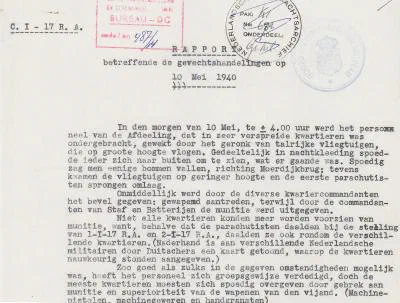
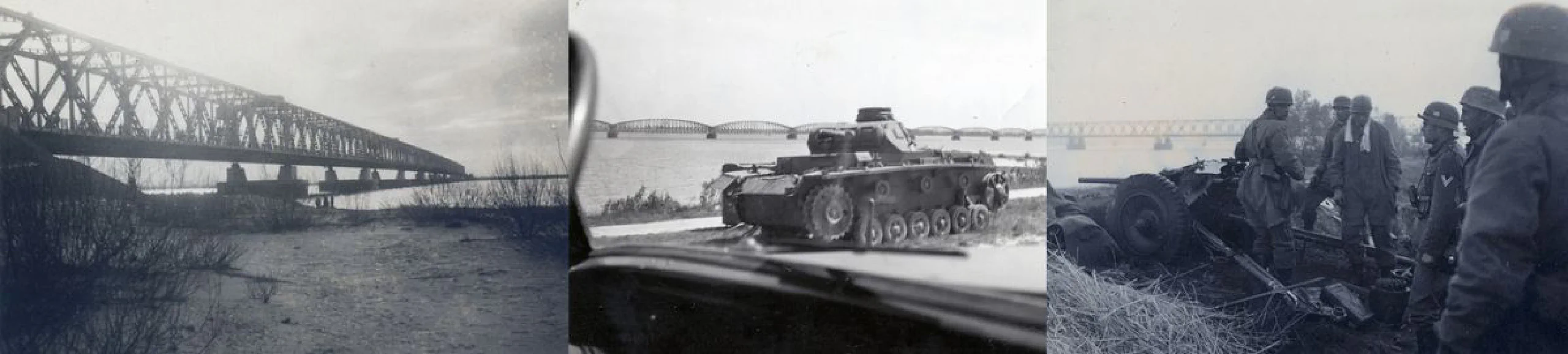
Captain Baretta had taken up position in the staff quarters together with artillerymen of 1‑I‑17 RA and 2‑I‑17 RA at the school on the (Rijks)Straatweg. There they came into contact with German paratroopers. Captain Baretta and his units of I‑17 RA were eventually forced to surrender because they had run out of ammunition to return fire. In this action, 23 men of I‑17 RA were taken prisoner of war, presumably including Hotze Jelle Kleefstra. Those who did manage to escape fled toward the Kiloever or Gravesteijn.3 4 The guns of I‑17 RA fell into German hands undamaged and were later even put to use by German paratroopers.
Then follow the photographs from Hotze Jelle’s mobilization period. In the first photo you can see the Killesigt farm; as explained earlier, this farm was located at the southwestern point of what is now Dordtse Kil III. The farm no longer exists. It was presumably his quarters during his mobilization period in Dubbeldam and Wieldrecht. Several group photos can be seen—presumably comrades of the 2nd Battery, 1st Battalion, 17th Artillery Regiment. If you zoom in on photo 5, the artillery collar insignia are still clearly visible, especially on Hotze Jelle. In October 1995, Hotze Jelle was awarded the Mobilization War Cross. His son wrote to me in a letter he enclosed with the photographs: “Unfortunately, I have little information to accompany them, because my father never wanted to speak about this. The little he did say was that it had been a horror.”
We will never know exactly what Hotze Jelle experienced during the May Days of 1940, but with additional research the story has now become more complete. Of the 2nd Battery, 1st Battalion of the 17th Artillery Regiment, four men were killed:”
- Sergeant J.J.L. van Geel.
- Conscripted soldier A.H. Groothuis.
- Conscripted soldier H. Loomulder.
- Conscripted soldier B. Mulder.
“Another ten soldiers from the other units of I‑17 RA were killed in May 1940.5
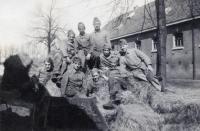
1. A group photo in the hay at the Van Essen barracks in Ede during the mobilization.
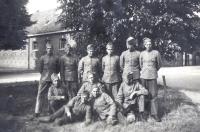
2. A group photo in the hay at the Van Essen barracks in Ede during the mobilization.
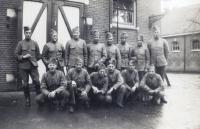
3. And one last group photo at the Van Essen Barracks in Ede during the mobilization.
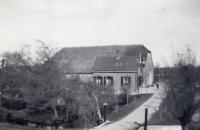
4. Hoeve Killesigt, near the Kiloever in Dordrecht during the mobilization.
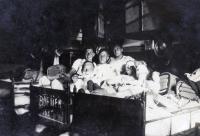
5. Hotze Jelle and his comrades of 2-I-17 RA during the mobilization in Dordrecht.
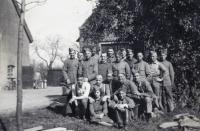
6. A group photo at Hoeve Killesigt in Dordrecht during the mobilization.
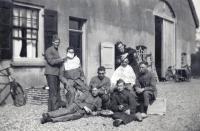
7. A haircut at Hoeve Killesigt in Dordrecht during the mobilization.
Source: Mr. Gerard Gijsbertsen kindly provided me with the information that the first three photographs were taken at the Van Essen Barracks in Ede. ↩︎
Source: Archieven.nl - 409 gevechtsverslagen - Pak K XII Zuidfront Vesting Holland - Groep Kil - Artillerie in de groep Kil - Verslag Kapitein Baretta. ↩︎