
2. Uniform Army Maritime Engineers 1st lieutenant
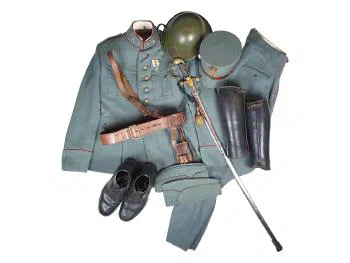
This “buitenmodel” uniform belonged to a First Lieutenant of the Corps of Army Maritime Engineers from the Dutch mobilization period. It is a field‑grey “buitenmodel” uniform, recognizable by the characteristic unfinished anchor of the Army Maritime Engineers. This emblem is clearly visible on the collar, together with the two red piping lines along the top and bottom edges. The two stars on the collar indicate the rank of First Lieutenant. The tunic features four pockets and is made of the so‑called ribcord fabric, which is characteristic of the later types of “buitenmodel” uniforms. The tunic, trousers, two side caps, and the kepi originally belonged to the same officer. To present the uniform as a complete set, shoes, gaiters, belt, sabre, and a helmet have been added.
Officers at the time received a reimbursement for purchasing a “buitenmodel” uniform. This type of uniform was custom‑fitted and made by a tailor. In some cases, non‑commissioned officers and enlisted men also acquired a “buitenmodel” uniform, but the cost was high and could reach up to sixty guilders. As a result, relatively many “buitenmodel” uniforms have survived to this day, while coarse wool uniforms for enlisted men are scarce. The latter had to be handed in during the occupation and were extensively reused and altered by the German forces to match German uniform models. Because “buitenmodel” uniforms were privately purchased, they almost always remained in private possession — as is the case with this example.
Inside this tunic there is still a name label, although the name is unfortunately no longer legible. For the presentation of this uniform, a ceremonial style of wear with sabre has been chosen. The large sizing is particularly striking: this is uncommon for Dutch uniforms of the period and indicates that the wearer must have been an exceptionally tall or broad man.
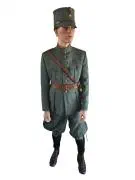
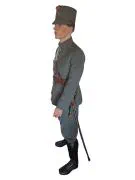
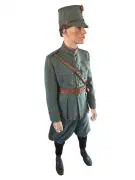
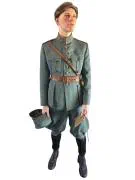
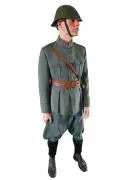
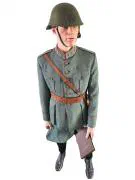
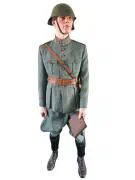
The first three photographs above provide a clear depiction of the First Lieutenant wearing his officer’s kepi. The Corps of Army Maritime Engineers did not use a regimental number on the kepi. Instead, they wore a Dutch lion emblem on both the kepi and the side cap. In the following photographs, the helmet is shown as an alternative form of wear. Attached to the officer’s belt is a Yzerhouwer sabre. In the field — including during May 1940 — the klewang was typically carried. The sabre, on the other hand, was mainly worn during ceremonial occasions.
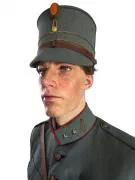
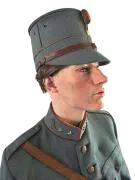
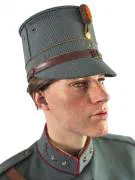
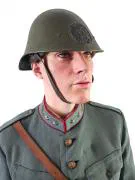
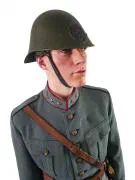
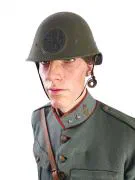
These close‑up photographs provide a clear view of the emblem of the Corps of Army Maritime Engineers: the unfinished anchor on the collar. The red piping is also clearly visible, as are the First Lieutenant’s rank insignia — the two stars.
The mannequin was painted by New Standard Museum Mannequins