
1. Uniform Corps Army Maritime Engineers 1th lieutenant
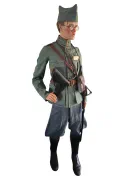
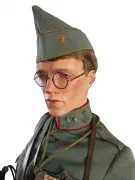
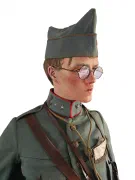
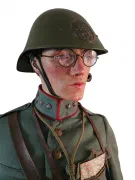
Below you see a uniform of the Korps Pontonniers en Torpedisten (Army Maritime Engineers) from the Dutch mobilization period. It is a field‑grey “Buitenmodel” (Private tailored) tunic featuring the characteristic unfinished anchor emblem of the Army Maritime Engineers branch. This emblem is visible on the collar, combined with the two red piping lines along its upper and lower edges. The two stars on each side indicate that the tunic belonged to a First Lieutenant of the Army Maritime Engineers. The tunic has four pockets, and the fabric clearly shows that this is an officer’s private tailored uniform rather than the coarse wool type typically worn by enlisted men and often by non‑commissioned officers as well.
Officers were eligible for a reimbursement for purchasing a private tailored uniform. They also received a higher salary, which made such a purchase more affordable. This is one of the reasons why many private tailored uniforms have survived to this day, while only few coarse‑wool uniforms remain. The latter had to be handed in by Dutch soldiers during the occupation and were eagerly reused and converted into German‑style uniforms by the Germans. The private tailored uniforms often remained in private possession. This tunic is an example of that. Unfortunately, it is not named.
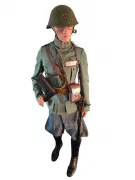
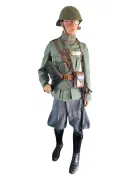
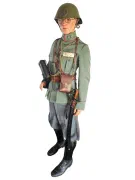
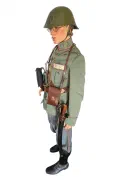
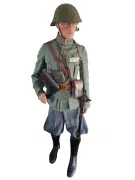
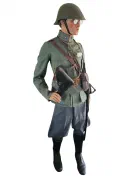
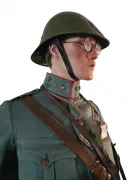
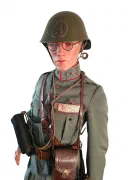
This mannequin represents a First Lieutenant of the Korps Pontonniers en Torpedisten as he would have appeared in May 1940. In the first photographs he is wearing his side cap, and in the later photographs his helmet. In his left breast pocket, the lieutenant has placed a staff map of Dordrecht. Over his uniform he wears the standard Sam Browne belt, as used by officers of the pre‑war Dutch Army. Attached to it are several items. First, the M1873 revolver holster, which would normally contain the M1873 revolver — a standard sidearm for Dutch officers and also for NCOs of the Army Maritime Engineers. On his hip he carries the klewang. Although this weapon was primarily practical within the KNIL (Royal Netherlands East Indies Army) as a tool for moving through jungle terrain, in the European Dutch Army it held more of a traditional significance. Nevertheless, the klewang was worn by many Dutch officers and NCOs during May 1940.
Looking further, we see trousers that differ in color from the tunic — something that occurred from time to time. Usually, the private tailored uniform matched in color because it was purchased as a complete set by the officer. However, trousers were often the most prone to wear, which meant that buying additional pairs was sometimes necessary. It was therefore not always guaranteed that a replacement pair would match the original color exactly. These trousers also feature a red stripe, just like the tunic — customary for officers. Over the trousers, the lieutenant wears puttees. Beneath the puttees we see black shoes, which were also often privately purchased, for which officers could receive reimbursement. This Army Maritime Engineer officer also carries a camera around his neck.
In the photographs below, this officer is wearing his side cap (kwartiermuts). Side caps were still regularly worn in the field or during marches, alongside the kepi. In combat situations, of course, the helmet was worn. The side cap with a gold piping was issued to officers and was identical across all branches and services. On the side cap is an Orange Lion. Officers of regular regiments often wore a number on their side cap, but officers of the Corps of Army Maritime Engineers wore a small orange lion instead.
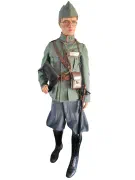
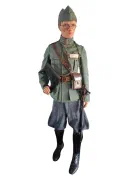
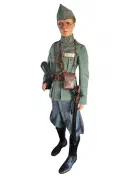
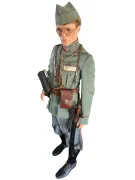
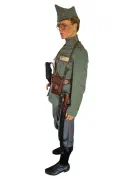
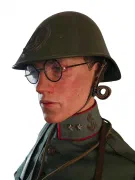
In the following series of photographs, the Dutch helmet can be seen, featuring the characteristic lion emblem. The helmet was generally identical for all soldiers and had no distinguishing features indicating officer rank, unlike in some other countries. In combat situations, the helmet would be worn. Also visible is the so‑called Sam Browne belt, equipped with a klewang or sabre hanger. This belt was intended for officers and was of the same model as those worn by British officers. The sabre hanger, as the name suggests, provided a place to carry a sabre or klewang.
The mannequin was painted by New Standard Museum Mannequins