
2. Officer's kepi Jaap Elias B.Vest Dordrecht
Below you can see a grey-green kepi for an officer of the pre-war Dutch army. The kepi was an official headgear for Dutch military personnel until 1931. After that, the side cap (kwartiermuts) was commonly worn. In many cases, the kepi continued to be worn depending on the unit. 1
The grey-green kepi had different variations for various military units. There were also distinctions made between the kepi for enlisted personnel and non-commissioned officers, the kepi for officers, and the kepi for senior officers. The kepi for enlisted personnel and non-commissioned officers featured two piping stripes of a specific color. These colors indicated the branch or arm of service the soldiers belonged to. For example, blue represented infantry, red represented artillery, and there were other colors as well. The kepi for officers had two gold piping stripes, while the kepi for senior officers had three gold piping stripes. Additionally, each kepi was adorned with either the Dutch lion emblem or a regimental number.
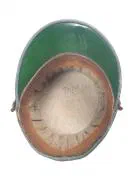
The latter makes it difficult to associate a specific unit with the kepi below. What makes this kepi particularly special is the fact that it has a name written on it:
“Jaap Elias” Dordrecht B.Vest.
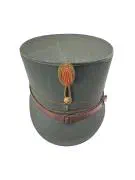
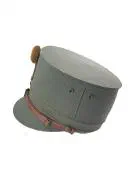
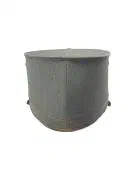
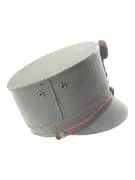
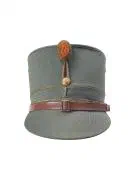
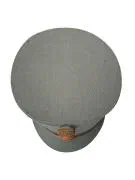
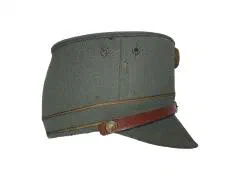
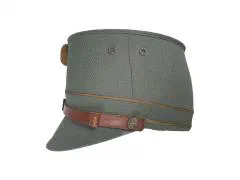
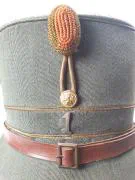
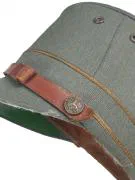
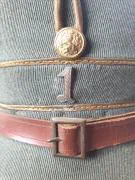
The above photos clearly show the two gold piping stripes, indicating that this kepi is an officer’s kepi. The regimental number is 1, which could potentially refer to the 1st Infantry Regiment or the 1st Artillery Regiment, for example. I have tried to research the name Jaap Elias, but so far, I have found no results. He is not listed in the name and rank records of the Royal Army, although it’s possible that these records are not complete. The bottom two photos are detailed shots of the sides of the kepi. The holes that you see on the side are ventilation holes. The gold piping stripes and the chin strap, attached on both sides with lion buttons, are clearly visible.
Below are some detailed photos of the kepi and the names written inside. These photos show the regimental number, cockade, and chin strap clearly. Inside the kepi, it appears that the name Jaap Elias is written with a pen. Additionally, the sweatband bears the inscription J. Elias Dordrecht B.Vest.
Based on the available information, it is likely that this kepi belonged to a gentleman named Jaap Elias who resided on the Binnen or Buiten Walevest in Dordrecht during his military service. Another possibility is that he was an officer stationed at the Pontonnierskazerne or Benthienkazerne on the Buiten-Walevest in Dordrecht. In this case, he would not have been a Pontonniers officer, as they wore a lion emblem on their kepi instead of a regimental number. It is possible that Jaap Elias was an infantry or artillery officer assigned to the Pontonniers and Torpedisten corps.
Unfortunately, the information is unclear at this point, and it may require further research or additional details to determine Jaap Elias’s specific military role and affiliation.


Source: westervoort1940 ↩︎