6. Mannequin – Domestic Armed Forces Dordrecht
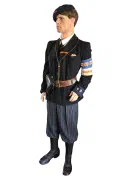
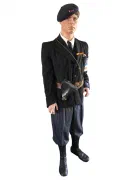
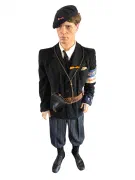
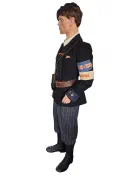
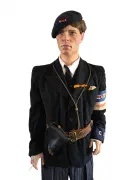
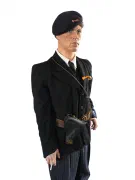
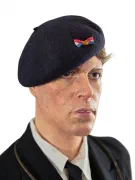
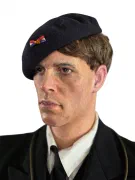
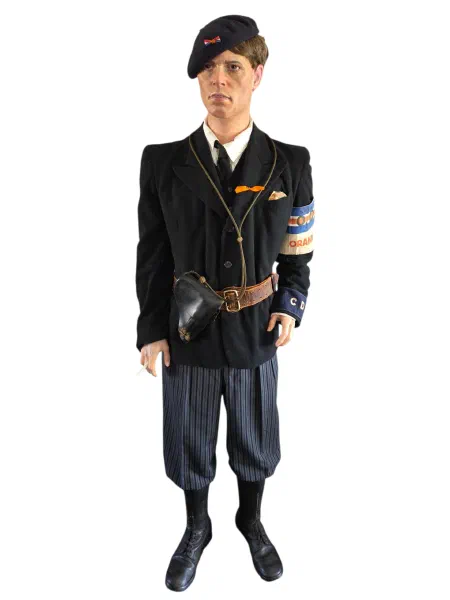
In this photo series, you see a mannequin portraying a member of the Dordrecht Domestic Armed Forces.
During the liberation of Dordrecht in May 1945, many photographs were taken of members of the Domestic Armed Forces in the city. During this period, members of the BS attempted to dress as uniformly as possible, ensuring that the insignia and armbands they wore were placed consistently on their attire. The clothing worn was often a blue overall or other civilian garments mixed with military or police equipment. In general, members of the Dordrecht Domestic Armed Forces wore a black alpine cap, or in some cases a military side cap. Most BS members wore a Sam Browne officer’s belt, while some used British webbing belts and even German service belts. In many cases they were armed with a Sten Gun, either the MK II or MK III model, and occasionally the MK V. Some members of the Dordrecht NBS were also equipped with the Dutch M25 pistol or the M1873 revolver, both weapons used by the Dutch army in May 1940. German weapons were also used, though less frequently.
In this composition we see a member of the Dordrecht Domestic Armed Forces dressed in civilian attire. He is wearing an alpine cap. To distinguish themselves, members of the Domestic Armed Forces wore armbands or sleeve bands along with other identifying insignia. Based on existing photographic material, these bands were always worn on the left arm. On the left sleeve here we see an OD armband. The Ordedienst armband was intended for members of the Ordedienst, one of the Dutch resistance organizations that consisted mainly of former military personnel. The band was made up of several colored stripes: first blue, then white, then orange, followed again by white and blue. In the upper blue section the word “Oranje” was printed in black. In the white‑orange‑white section the black printed letters “O.D.” appeared. The O.D. armband was worn above the Orange armband on the left sleeve.
Beneath his Ordedienst armband, this BS member also wears an Orange armband, as commonly seen in Dordrecht during the liberation. The second armband worn on the left sleeve was the Orange armband, used by members of the Dordrecht Domestic Armed Forces. The Domestic Armed Forces in Zwijndrecht also wore this type of armband, and it may have been used in other Drecht cities during the liberation as well. It is a white armband with the word “Oranje” printed in orange. This armband existed in several variants to indicate different ranks within the BS organization:
- The standard Orange armband for regular members
- A version with a single black stripe for section commanders
- One with two black stripes, likely for platoon commanders
- A version with a thick black stripe and a thin black stripe, possibly intended for company commanders
- Another with a thick black stripe, a thin black stripe, and a curl for district commanders
- And finally, an Orange armband printed with the word “STAF” for staff personnel.
Beneath his OD and Orange armbands, this member of the Domestic Armed Forces also wears a CD armband on his sleeve. During the liberation, several types of Allied armbands were worn, each serving a different purpose. Photographic evidence shows that the British C.D. armbands were used; these were blue armbands with the white letters “C.D.,” standing for Civil Defense. Wearing this armband granted the bearer permission to carry a firearm in public. In addition, the British M.P. armband was sometimes worn, indicating Military Police.
On his hip, this BS member wears a Sam Browne officer’s belt, as used by officers of the Dutch army. The cross‑strap is not worn here. Attached to the belt is a black M25 police holster for the M25 pistol, complete with pistol lanyard, a type also used by both the Dutch army and police. This BS member also wears black leather gaiters. The use of military equipment among members of the Domestic Armed Forces was very common. De mannequin is beschilderd door New Standard Museum Mannequins