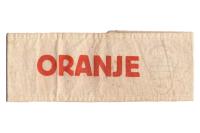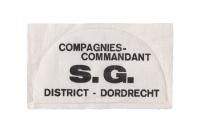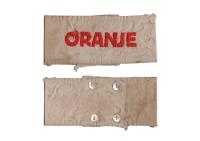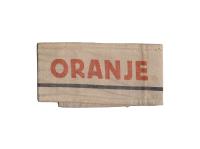
The Dutch Domestic Forces in Dordrecht.
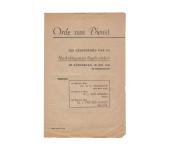
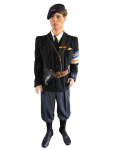
On this page, you can find various items related to the Domestic Armed Forces (Binnenlandse Strijdkrachten) in the Dordrecht region.
The Binnenlandse Strijdkrachten were formed in September 1944 as a result of the Dutch government‑in‑exile’s decision in London to merge the various resistance organizations in the Netherlands into a single national force. Until then, the different resistance groups had operated largely independently, each with its own background, methods and priorities. By bringing them together, the government created a structure that could function during the liberation as a temporary internal army, intended to maintain order, coordinate sabotage, and ensure that the transition from occupied to liberated territory would proceed as smoothly as possible.
The BS consisted of three major branches. The Ordedienst was a group that had begun preparing early in the war for the moment of liberation and focused primarily on maintaining public order. The Landelijke Knokploegen grew out of the networks that supported people in hiding and were accustomed to sabotage and armed operations. The Raad van Verzet was a smaller and more radical group that engaged in direct combat against the occupier. Because of these very different backgrounds, the BS became a diverse collection of former soldiers, young resistance members, police officers, and civilians who joined only in the later stages of the war.
Their role was primarily focused on managing the transition from occupied to liberated territory in the Netherlands. They were responsible for securing bridges, roads and key buildings, assisting in the arrest of collaborators, carrying out sabotage operations and conducting raids. At the same time, they served as a point of contact for the Allied forces, who in the chaotic weeks of liberation depended heavily on local knowledge and support. In some areas, the BS acted as temporary law‑enforcement units, either because the regular police was not functioning or because the situation on the ground was too unstable.
From the very beginning, the BS were placed under the command of Prince Bernhard, who had been appointed by the Dutch government‑in‑exile in London as their commander. His role was largely symbolic and organizational: he was responsible for maintaining unity among the various resistance groups, gaining the trust of the Allied forces, and ensuring that the BS could operate as a reliable partner during the liberation. Under his leadership, the BS developed a clearer military structure, adopted recognizable armbands, and obtained a formal position within the liberation operations.
In Dordrecht, the Binnenlandse Strijdkrachten consisted of the Ordedienst, the National Organization for People in Hiding (LO), and the National Assault Groups (L.K.P.). Dordrecht belonged to District 14. The Binnenlandse Strijdkrachten were divided into a Fighting Section (S.G.) and the Guard Troops (B.T.). This was also the case in Dordrecht. In District 14, the organization was as follows:
1st Battalion, Fighting Section, District Dordrecht:
- 1st Company Dordrecht
- 2nd Company Dordrecht
- 3rd Company Dubbeldam
- 4th Company IJsselmonde East
- 5th Company Hoekse Waard
2nd Battalion, Fighting Section, District Dordrecht:
- 6th Company Alblasserwaard West
- 7th Company Vijfheerenlanden East
- 8th Company Alblasserwaard East 1 - 2